My first texan article is out! and accessible in open access: https://analyticalsciencejournals.onlinelibrary.wiley.com/doi/10.1002/sia.70084
Serendipity rules science! This endeavour started by preparing cholic acid surfaces to study the secondary ion emission in the case of heavier molecules and compare that with lighter organic molecules, silicon and metals. Well, this is not exactly what happened as you can imagine. To prepare the surfaces, we were facing several options and screening the litterature did not help. It is astonishing to see how little is known about a molecule which is present in our digestive system.
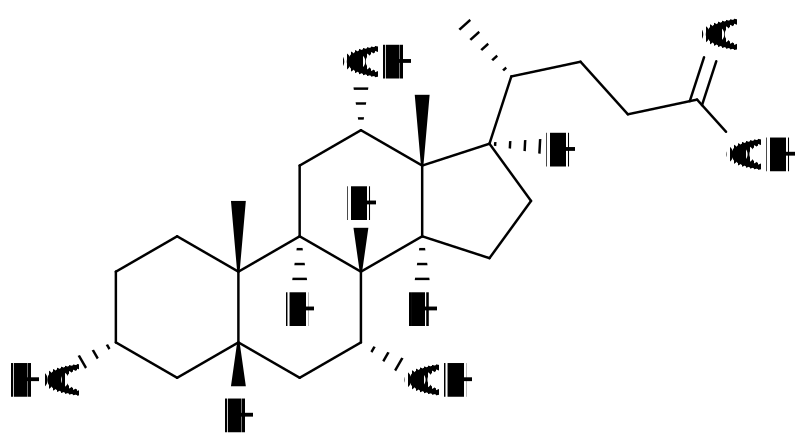
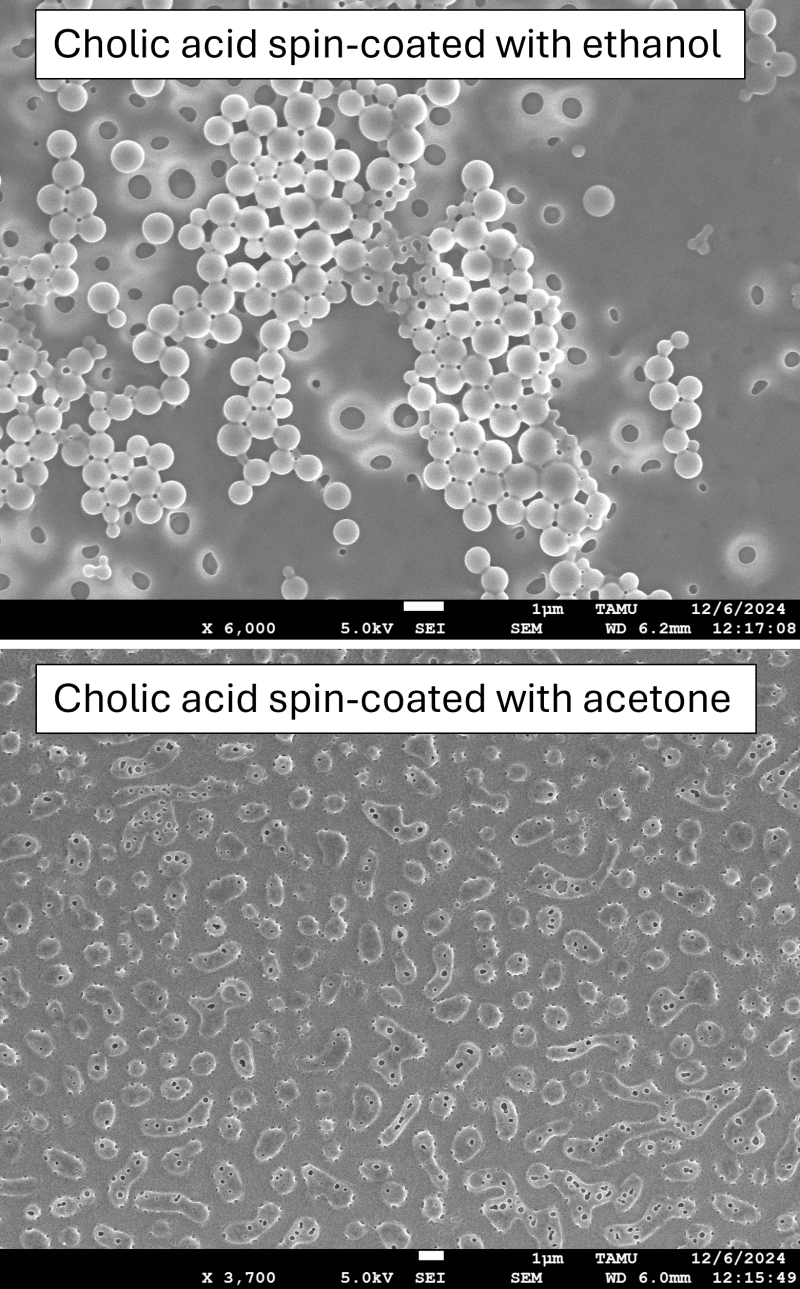
Indeed, I couldn't find any information on its sublimation temperature if there is any, and I did not wanted to damage our sublimation device to test that. The other option I was considering, was spin-coating. Turns out cholic acid is soluble in ethanol and acetone, two excellent solvents for spin-coating preparation. The molecule of interest is soluble in them and they evaporate quickly. I tried both with the same concentrations. Both resulted in a whitish deposit. I acquired the mass spectra for both surfaces. Some time passed before I could do any data analysis on them. The story could stop here, but no. It continues.Eventually, we did scanning electron microscopy (SEM) and there was the revelation! The two solvent created very different surface structures: spheres with ethanol and a porous surface with acetone (see picture on the left). Not only are these structures beautiful, they resulted just from a difference in solvent. All other parameters were the same. We needed to know more about these structures, so we did atomic force microscopy (AFM). We could then get more information on the sizes of these structures but also the general roughness of the surfaces. Our interest was sparked, so we did finally started the analysis of the mass spectra. The results are amazing. In all the aspects of the mass spectra we could see the difference between the two surfaces, their difference in structuration, hence the impact of the respective solvent. We were able to see differences in the fragmentation pattern of the cholic acid, which gives some information on the effect of the molecular arrangement as well as the surface topography. The combination of these parameters is called the matrix effect. You can read the scientific details following this link.
I want to thank all the coauthors for their help in acquiring the data, treating and understanding them and for their support in writing the article.
Add comment
Comments