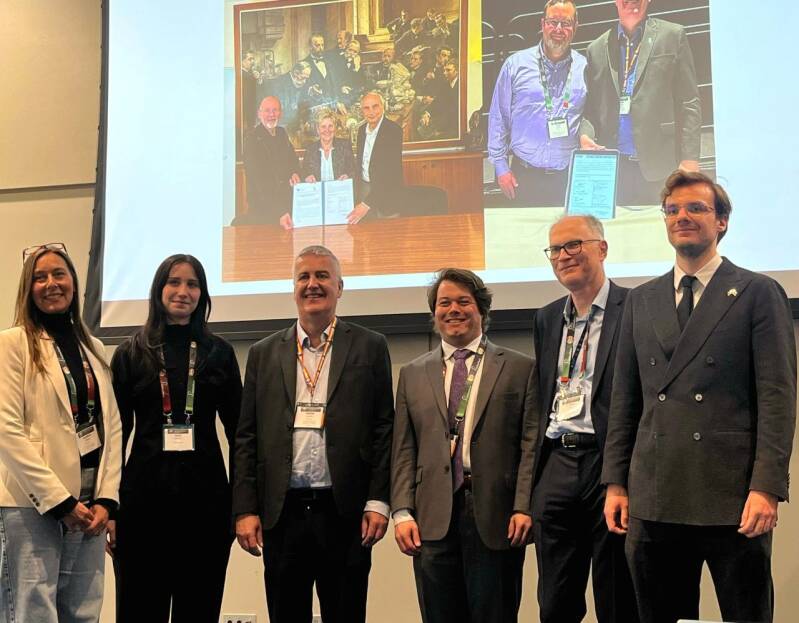
From left to right: Kathryn Preuss (Vice-president of CSC), Suzie Bronner (Scientific cooperation officer, CNRS), Jérôme Claverie (President of the CSC), myself (as vice-president of the French Chemical Society), Florent Louis (the instigator of the MOU between our societies), Grégoire Dusseux (Science and Technology Project Officer for the French Embassy in Canada)
What a blast ! Two weeks ago, I had the opportunity and pleasure to participate in x2026 organized by the Chemical Institute of Canada (CIC) and hosted jointly by the Canadian Societies for Chemistry and Chemical Engineering (CSC and CSChE). It was quite an intense week on the scientific level, and on the diplomatic level.
First, I was given the opportunity for the first time in my career to present a keynote presentation on my work as a postdoctoral research fellowat Texas A&M. Especially, I could present in depth the NP-SIMS technique and how we are applying it to analyze small extracellular vesicles. Although, we are still in the very early stages of this research, the results I presented are promising (an article should be coming this Fall on the subject) and open the path to a better understanding on these biological objects with the potential to better diagnose illnesses and in the end help to save lives.
Secondly, also a first time for me, I had the honor of representing the French Chemical Society as its Vice-president for young chemists to the Canadian Society for Chemistry (CSC). This was not just for the fun (although it was a lot of fun), but to kick start the memorandum of understanding (MOU) between our two societies, bringing Canada and France closer together as scientific partners.
This couldn't have happened without the hard work and dedication of Florent Louis from the University of Lille. He managed to convince the two societies to back his project and gathered chemists on both side of the Atlantic to create a committee to discuss, negotiate and write the MOU. He even got the support of the French Consulate, who helped in the realization of this agreement financially, and humanly. The agreement was signed on both sides prior to the x2026 conference, and we had the pleasure to announce the signature publicly in Toronto. It was the occasion to present the French Chemical Society to our Canadian partners, our missions, our organization, our activities. Since Canada is a bilingual country, the announcement was made in French, during one of the conference session held in French. The conference ended with a festive moment celebrating French language in Science. x2026 was definitely an event beyond pure science. It was a moment of exchange and discussions, about Chemistry (of course) but also research policies, scientific diplomacy, outreach to the general public, teaching Chemistry, etc...
This could have stopped here, but no. As a part of the French delegation, I had the pleasure and honor to be invited for lunch at the Résidence de France in Toronto, where we met with Bertrand Pous, the French Consul in Toronto. It was a nice occasion to discuss about French scientific diplomacy, the relations between Canada and France, and maybe some other projects we can't tell about just yet. (And yes the food was excellent ;) )

It is not an understatement to say that this week was intense on many levels. I met so many amazing and inspiring people. I learned a lot on Chemistry, and finally I added a little contribution to strengthen our relationship with the CSC.
Add comment
Comments