This Summer was eventful on many levels and for me it was a three week long travel through Europe, where I first attended the general congress of the French Chemical Society (SCF'26), then moved to Lyon to visit some friends, to continue the journey by going to Italy for the Gordon conference on Biointerphases, moving to England next and finally going back home to Alsace visit my family. I also published two articles in Surface Science Spectra. Since it is a longer blog post then usually, there will be sections to ease the reading.
A sip of Bordeaux ? This time rather water
Let's start in Bordeaux. This was probably the most impressive congress I have ever seen in my career. Due to the heat wave the event had to be completely reorganized in less than 24 hours! It was done and all who could, helped to make it a success anyway. Despite the heat and the epic conditions, scientific exchange prevailed and to my opinion being in the unknown of what would happen triggered more exchange with less social barriers than in a usual conference. Though I would not recommend to redo that anytime soon. Some orals were saved and webinars will be organized to compensate for those who couldn't. Some of the posters were also saved by making the very first online poster session on LinkedIn. You can still find them by searching #SCF26 and #SCFcanicule on LinkedIn.
It was a stressful experience, but it was worth the effort. I could see some old friends, make new ones and discuss future projects for the French Chemical Society and its young Chemist Network. Maybe we drank more water to stay hydrated, but Chemistry is solution science.
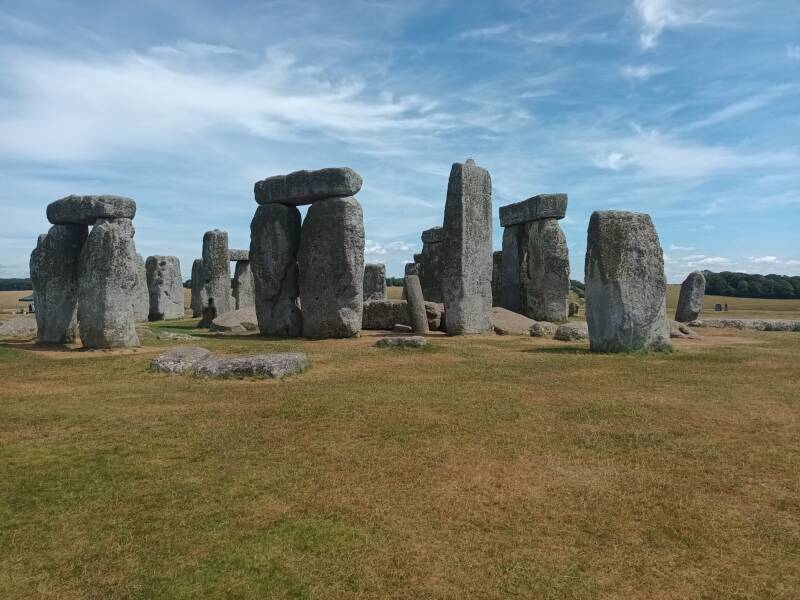
A photo of Stonehenge, which I had the chance to visit at the end of my european tour. I was so buisy in Bordeaux I didn't get the chance to make photos...
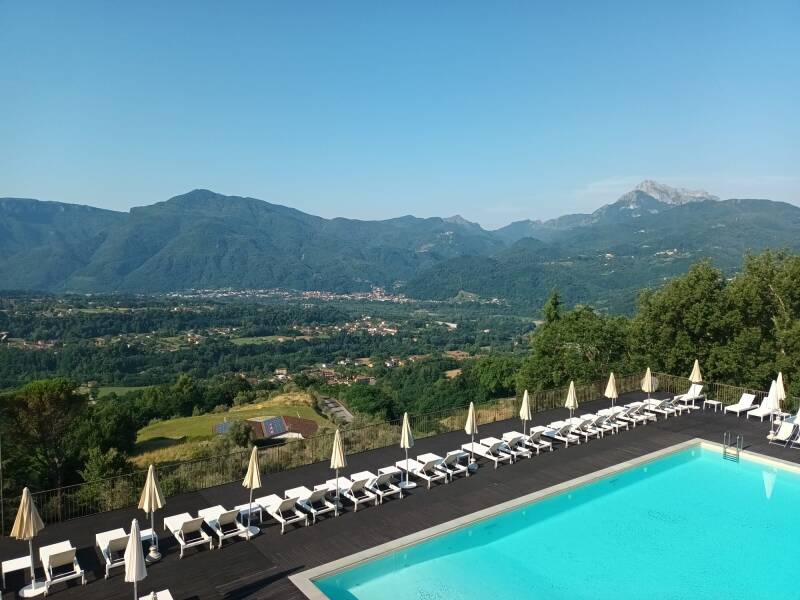
A view from the hotel's terrasse in Italy where the Gordon conference was held.
A taste of Italy
First time in Italy and first time at a Gordon conference. It was a blast! I met many great scientists in the field of Biotinterphases and made many new friends across the world. The discussions had with the all the scientists present there definitely helped me advance on some questions and pitfalls I had in my research. I also learned a lot of new science and surely brought new ideas I'd like to test some day.
As you can see on the picture on the left, the location was wonderful and helped me to recharge my batteries after the adventures in Bordeaux. The excursion organized during the conference made the stay much more enjoyable than it already was, especially the cave visit to cool down from the hot weather outside. The excursion to Lucca was also amazing and made me want to go back and visit more of Italy.
Publications in Surface Science Spectra
As a scientist it is always a great satisfaction (if not joy) to see one of your articles being published. This time the satisfaction is thrice. Two articles being published in the span of two weeks is a lot and are two reasons to celebrate. The third reason is that these two articles are being published in the journal Surface Science Spectra. This journal is a one of kind type of journal. The aim of this journal is to publish thoroughly peer-reviewed spectral data coming from four techniques: X-ray photoelectron spectroscopy [including Auger electron spectroscopy (AES), Low Energy Inverse Photoemission Spectroscopy (LEIPS), and Bremsstrahlung Isochromat Spectroscopy (BIS)], time-of-flight secondary ion mass spectrometry (ToF-SIMS), low energy ion scattering (LEIS) spectroscopy, and optical measurements including spectroscopic ellipsometry (SE) and ultraviolet-visible spectroscopy (UV-vis). These spectra are to serve the scientific communuty to share data, share observations and give reference spectra for spectral libraries.
After some discussion with the editors, they decided to create a specific spectra collection dedicated to NP-SIMS data articles. We thank the editors for this decision. It will allow us in the future to continue to publish reference spectra obtained in NP-SIMS and share them with the scientific community. These two articles are small contributions to open science, but made me grow as a scientist. One cannot emphasize enough the importance of making our data findable, accessible, interoperable and reusable. The principles of FAIR research (https://www.go-fair.org/).
Now, the content of these articles!
The first article present a negative mode spectrum of cholic acid spin-coated with acetone: link
The second article displays negative mode spectra of gold and silicon substrates: link
Add comment
Comments